

A bulk SMS service allows businesses to send large volumes of text messages instantly for marketing, alerts, and transactional updates. With extremely high open rates and fast delivery, bulk SMS remains one of the most effective communication channels for reaching customers directly. By using a reliable platform with automation, analytics, and SMS API integration, businesses can scale their messaging, improve engagement, and drive better conversions.
A bulk SMS service lets businesses send large volumes of text messages to customers at once—for marketing, alerts, or notifications. With open rates near 98%, it’s one of the most direct ways to reach an audience. The best platforms combine campaign tools, automation, and a reliable SMS API to deliver messages at scale.
Email gets ignored. Social posts get buried. But a text message? People read it within minutes of receiving it. That simple fact is why so many companies—from local retailers to global enterprises—lean on bulk SMS to cut through the noise.
This guide breaks down what a bulk SMS service is, how it works, and what to look for when choosing one. You’ll learn how mass text messaging supports marketing, customer service, and operations, plus the features that separate a basic tool from an enterprise-grade platform. By the end, you’ll know exactly how to put SMS to work for your business.
What is a bulk SMS service?

A bulk SMS service is software that sends large numbers of text messages to multiple recipients simultaneously. Instead of typing messages one by one, you upload a contact list, write your message, and send it to hundreds or thousands of people in seconds.
These services run on dedicated infrastructure that connects to mobile carriers worldwide. That connection—often called an SMS gateway—is what allows your message to travel from a web dashboard or app straight to a customer’s phone.
Businesses use bulk SMS for a wide range of purposes:
- Marketing promotions: Flash sales, discount codes, and product launches
- Transactional alerts: Order confirmations, shipping updates, and payment receipts
- Reminders: Appointment confirmations, bill due dates, and event notifications
- Authentication: One-time passwords and two-factor verification codes
The appeal comes down to attention. According to industry research, SMS messages have an open rate of roughly 98%, and most are read within three minutes. Few other channels come close.
How does a bulk SMS marketing service work?
A bulk SMS marketing service follows a straightforward process, though plenty of technology runs behind the scenes.
First, you build a contact list of subscribers who have opted in to receive your messages. Next, you compose your message—usually 160 characters or fewer for a standard text. Then you select your audience, schedule a send time, and hit send. The platform routes your message through an SMS gateway to the recipients’ carriers, which deliver it to their phones.
Most platforms also give you delivery reports. You can see how many messages were sent, delivered, and failed, plus how many recipients clicked any links you included. This data helps you refine future campaigns.
What’s the difference between an SMS gateway and an SMS platform?
An SMS gateway service provider handles the technical delivery of messages between your system and mobile networks. Think of it as the pipeline.
An SMS marketing platform, on the other hand, sits on top of that pipeline. It adds the tools you actually interact with—contact management, message templates, scheduling, analytics, and automation. Most business users want a full platform rather than a bare gateway, since it bundles delivery with everything needed to run campaigns.
Why use a mass text messaging service for your business?

A mass text messaging service offers benefits that other channels struggle to match. Here’s why companies invest in it.
Speed and reach. You can notify thousands of customers about a flash sale or urgent update within minutes. No printing, no postage, no waiting.
High engagement. Because people keep their phones close, texts get read fast. That makes SMS ideal for time-sensitive offers and alerts.
Cost efficiency. Compared to direct mail or paid ads, SMS is affordable—especially at scale. Many providers charge per message with volume discounts.
Personalization. Modern platforms let you insert a recipient’s name, recent purchase, or location into messages. Personalized texts feel less like spam and more like a useful note.
Measurable results. Detailed reports show exactly how each campaign performed, so you can prove ROI and improve over time.
What features should a business bulk SMS solution have?
Not all platforms are created equal. When evaluating a business bulk SMS solution, look for these core features.
Contact and list management
You need an easy way to import, segment, and organize contacts. Good segmentation lets you target the right people with the right message—for example, sending a promo only to customers in a specific city.
Campaign scheduling and automation
An SMS campaign management tool should let you schedule messages in advance and trigger them automatically. Welcome texts, birthday offers, and cart-abandonment reminders can all run on autopilot once set up.
Two-way messaging
Customers often want to reply. Two-way messaging turns SMS into a conversation, letting you answer questions, confirm appointments, or collect feedback.
Personalization and templates
Reusable templates save time, while merge fields add a personal touch at scale. Together they help you send relevant messages quickly.
Analytics and reporting
Look for real-time dashboards that track delivery rates, click-throughs, opt-outs, and conversions. Without data, you’re guessing.
Compliance tools
Built-in opt-out handling and consent tracking keep you on the right side of regulations like the TCPA in the U.S. and GDPR in Europe. Skipping compliance can lead to heavy fines.
What is a bulk SMS API provider, and do you need one?
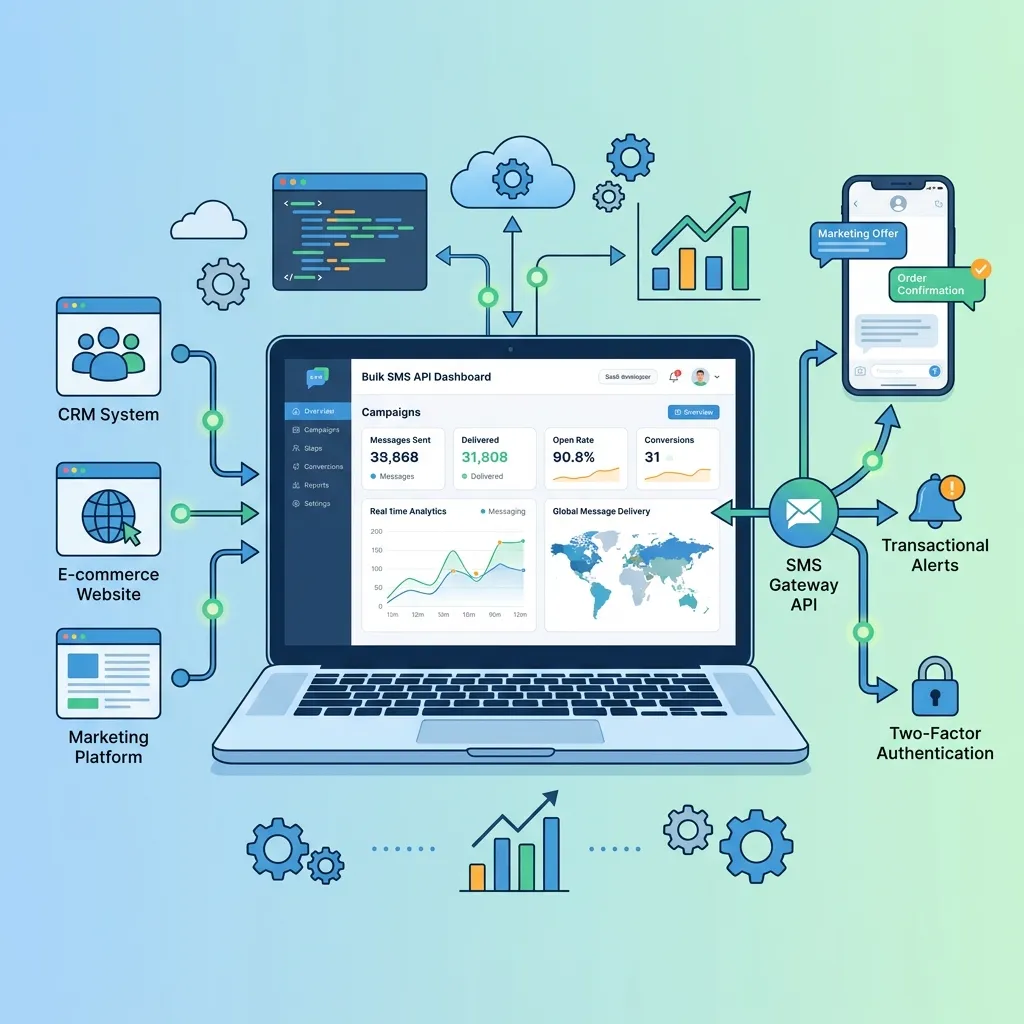
A bulk SMS API provider offers a way to send messages directly from your own software, website, or app—no manual dashboard required. An API (application programming interface) connects your systems to the SMS service so messages can fire automatically based on events.
For example, an e-commerce store might use an API to send an order confirmation the moment a purchase is completed. A bank might trigger a fraud alert when it detects unusual activity.
You should consider an SMS API if:
- You want to automate texts based on actions in your own software
- You’re sending transactional messages like receipts or OTPs
- You have developers who can integrate the API into your workflow
If you mainly run manual marketing campaigns, a standard dashboard may be all you need. But for high-volume, automated messaging, an API is essential.
How to choose the right SMS marketing platform
Picking the right SMS marketing platform depends on your goals, budget, and technical resources. Use these criteria to guide your decision.
Choose based on volume. If you send millions of messages, prioritize an enterprise SMS messaging service with robust infrastructure and high delivery rates. For smaller volumes, a simpler tool with pay-as-you-go pricing may fit better.
Choose based on use case. Need promotional blasts? Focus on campaign tools and analytics. Need automated transactional alerts? Prioritize a strong, well-documented API.
Choose based on support. Larger businesses often need dedicated account management and 24/7 support. Smaller teams may be fine with self-service help docs.
Check delivery rates and routing. A reliable SMS gateway service provider with direct carrier connections delivers messages faster and more consistently. Ask providers about their routes and uptime guarantees.
Review pricing transparency. Watch for hidden fees on setup, keywords, or short codes. Compare cost per message at your expected volume.
What’s the difference between promotional and transactional SMS?
Understanding this distinction helps you stay compliant and effective.
A promotional SMS service sends marketing messages—sales, offers, and announcements. These require explicit opt-in consent, and recipients must be able to unsubscribe easily.
Transactional SMS, by contrast, delivers information tied to a specific action, like an order confirmation or password reset. These messages are generally exempt from marketing consent rules because the customer expects them.
Mixing the two carelessly can cause problems. Sending a promotion through a transactional channel, for instance, may violate regulations. A good bulk SMS software for business keeps these message types properly separated.
Best practices for running bulk SMS campaigns
To get the most from your mass text messaging service, follow these proven tips.
- Always get consent. Only message people who have opted in. It’s the law, and it builds trust.
- Keep it short. Stick to clear, concise messages with one call to action.
- Time it well. Send during business hours and avoid early mornings or late nights.
- Personalize when possible. Use names and relevant details to boost engagement.
- Include an opt-out. Make unsubscribing simple with a “Reply STOP” instruction.
- Test and measure. Run A/B tests on message wording and timing, then refine based on results.
Putting bulk SMS to work for your business
A bulk SMS service gives you a fast, reliable, and affordable way to reach customers where they already are—on their phones. Whether you’re running promotional campaigns, sending transactional alerts, or automating notifications through an API, the right platform can transform how you communicate.
Start by defining your goals. Decide whether you need a simple campaign tool or a full enterprise SMS messaging service with API access. Then compare providers on delivery rates, features, compliance support, and pricing. A short trial or pilot campaign will quickly show you which platform fits your needs.
The businesses that win with SMS treat it as a relationship, not just a broadcast. Respect consent, deliver real value, and your text messages will become one of your most powerful marketing channels.
Frequently asked questions
How much does a bulk SMS service cost?
Pricing varies widely based on volume, country, and features. Most providers charge per message, often between a fraction of a cent and a few cents each, with discounts at higher volumes. Some add monthly platform fees or charges for dedicated short codes. Request a quote based on your expected send volume for an accurate estimate.
Is bulk SMS marketing legal?
Yes, when done correctly. You must get explicit consent before sending marketing texts and provide an easy way to opt out. Regulations like the TCPA in the United States and GDPR in Europe set strict rules. A compliant SMS marketing platform includes built-in consent and opt-out tools to help you follow them.
How fast can a mass text messaging service deliver messages?
Most messages arrive within seconds to a few minutes. Actual speed depends on the provider’s infrastructure, carrier routes, and the volume being sent. Enterprise-grade providers with direct carrier connections typically deliver the fastest and most reliable results.
Do I need technical skills to use a bulk SMS platform?
For standard campaigns, no. Most platforms offer user-friendly dashboards that require no coding. However, if you want to integrate SMS into your own software using a bulk SMS API provider, you’ll need a developer to handle the technical setup.
What’s the difference between a long code and a short code?
A long code is a standard 10-digit phone number, suited to lower-volume, two-way messaging. A short code is a 5-to-6-digit number built for high-volume sending and faster throughput. Short codes cost more but handle large campaigns better.