
An email to SMS gateway enables businesses to send text messages directly from email systems by converting emails into SMS messages. This technology helps organizations deliver automated alerts, notifications, reminders, and customer updates quickly and reliably. By integrating SMS with existing email workflows, businesses can improve communication, increase message visibility, and reach recipients instantly on their mobile devices.
An email to SMS gateway is a service that converts email messages into SMS text messages, delivering them directly to a recipient’s mobile phone. Businesses use email-to-SMS integration to send automated alerts, notifications, and bulk messages through their existing email infrastructure—no separate SMS app required.
Every day, millions of emails go unread. The average email open rate hovers around 20–30%, while SMS messages are opened at a rate of 98%—often within three minutes of delivery. For businesses that rely on timely communication, that gap is hard to ignore.
An email to SMS gateway bridges these two channels, letting you send text messages directly from your email client or software platform. No new tools. No separate logins. Just faster, more reliable delivery to the people who matter most.
This guide covers everything you need to know: how email to SMS gateways work, how to choose the right SMS gateway provider, and how businesses are using this technology to improve operations, cut response times, and reach customers where they actually pay attention.
What Is an Email to SMS Gateway?
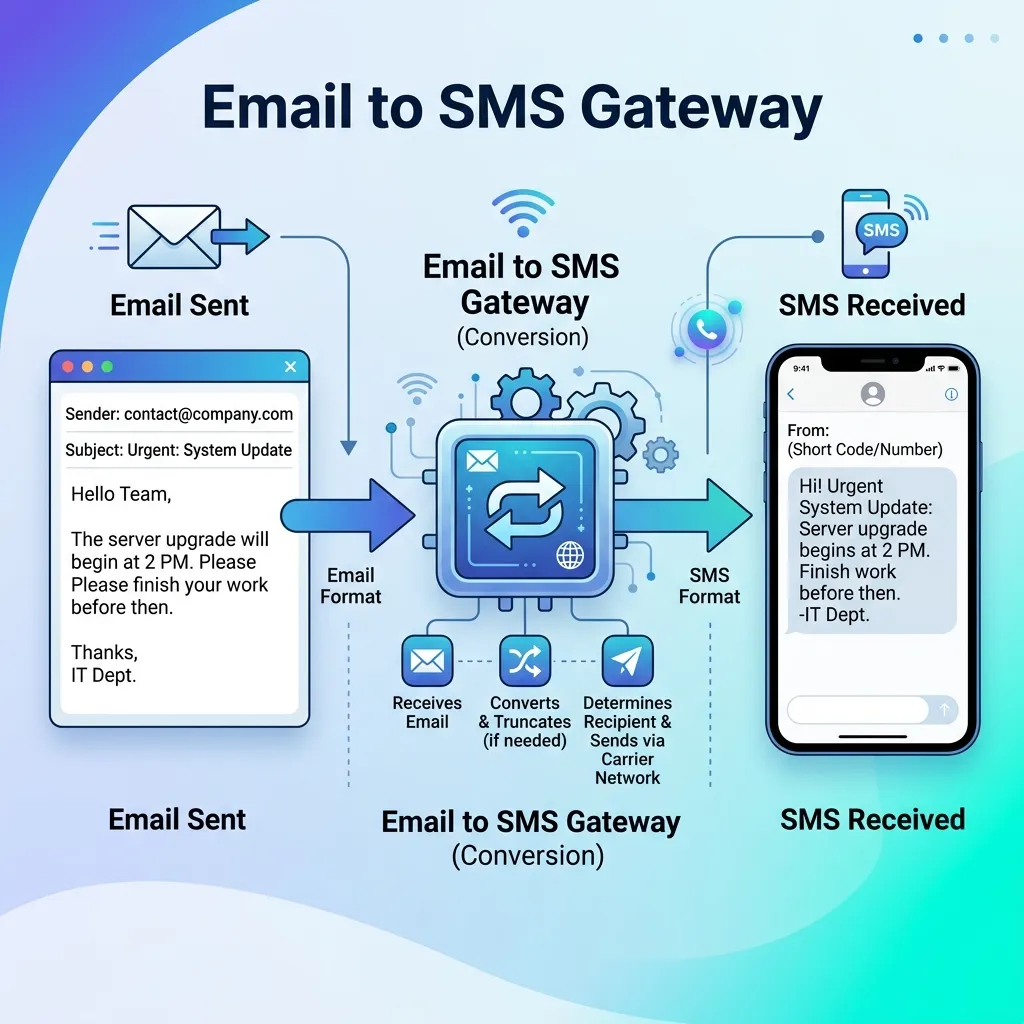
An email to SMS gateway—sometimes called an SMS email gateway—is a system that translates email messages into SMS format and routes them to a mobile phone number. When you send an email to a specific gateway address (typically formatted as [phonenumber]@[gatewayaddress].com), the gateway strips the email down to its SMS-compatible content and delivers it as a standard text message.
This process works in both directions. Some platforms also support SMS to email, meaning replies sent from a mobile phone are converted back into email messages and delivered to your inbox.
The core appeal is simplicity. Most businesses already have email infrastructure in place—marketing platforms, CRMs, ERP systems, and helpdesk tools that send transactional emails. An email to text messaging service lets you repurpose that same infrastructure to reach people via SMS, without rebuilding workflows from scratch.
How Does an Email to SMS Integration Work?
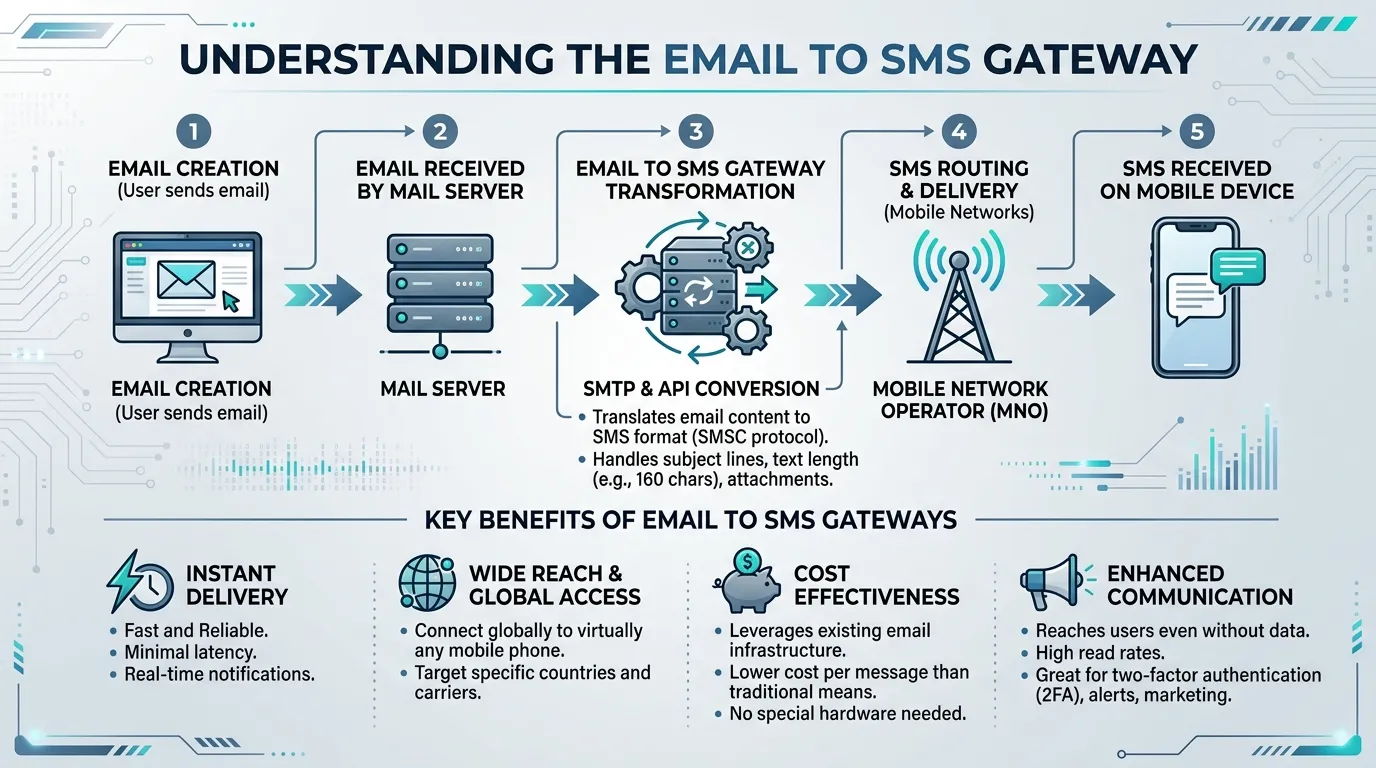
The technical process behind email to SMS integration involves a few key steps:
- Email is composed and sent from a standard email client or automated system.
- The SMS gateway receives the email via a dedicated gateway address tied to the recipient’s mobile number.
- The gateway converts the content into an SMS-compatible format (160 characters for standard SMS, longer for multi-part messages).
- The message is delivered to the recipient’s mobile number through carrier networks.
Most SMS delivery platforms handle the carrier routing automatically, ensuring messages reach their destination regardless of the recipient’s mobile network. Enterprise-grade platforms typically offer delivery receipts and reporting dashboards so you can confirm each message was received.
Some platforms also support API-based email to SMS integration, allowing developers to trigger text messages programmatically from within web applications, CRMs, and customer support tools.
What Are the Best Use Cases for Email to SMS Gateways?
Email to SMS gateways are versatile enough to support a wide range of business SMS communication needs. Here are the scenarios where they deliver the most value:
Automated SMS Alerts and System Notifications
IT teams, logistics platforms, and e-commerce businesses use automated SMS alerts to notify staff or customers the moment something changes. A server goes down. An order ships. A delivery is delayed. These are time-sensitive events that can’t wait for someone to check their inbox.
By routing automated email notifications through an SMS email gateway, teams receive real-time alerts on their mobile phones—even when they’re away from their desks.
Customer-Facing Notifications
Appointment reminders, booking confirmations, payment receipts, and shipping updates are all well-suited to SMS delivery. Customers are far more likely to see and act on a text message than an email, making SMS the smarter channel for anything requiring immediate awareness or action.
Internal Business Communication
Not every business SMS message is customer-facing. HR teams send shift reminders and emergency notices. Operations teams alert field workers about job assignments. Finance departments notify managers of approval requests. A text message gateway service allows internal teams to reach employees on mobile devices without requiring them to use a specific app or platform.
Marketing and Promotional Campaigns
While SMS marketing is subject to regulatory requirements (such as obtaining explicit consent under TCPA in the US and similar laws in other regions), it remains one of the most effective channels available. Businesses use email to SMS gateways to send promotional offers, flash sale alerts, and loyalty program updates to opted-in subscribers.
How to Choose the Right SMS Gateway Provider
Not all SMS gateway providers offer the same level of reliability, coverage, or features. Here are the key factors to evaluate before committing to a platform:
Geographic Coverage
If your business operates internationally, confirm that the provider supports delivery to the countries where your customers or staff are located. Coverage quality can vary significantly between regions.
Deliverability and Uptime
A text message gateway service is only as valuable as its ability to deliver messages reliably and on time. Look for providers with documented uptime guarantees (99.9% or higher), direct carrier connections, and real-time delivery reporting.
Pricing Structure
SMS gateway pricing models vary. Some providers charge per message, while others offer monthly plans with message allowances. High-volume senders typically benefit from per-message pricing with volume discounts, while lower-volume users may prefer a flat-rate plan.
Integration Compatibility
Choose an SMS delivery platform that integrates with the tools your team already uses. Many leading providers offer native integrations with platforms like Salesforce, HubSpot, Zendesk, and Microsoft Outlook, as well as REST APIs for custom integrations.
Compliance and Security
Reputable SMS gateway providers support compliance with regional regulations, including TCPA (US), GDPR (EU), and CASL (Canada). Look for platforms that offer opt-out management, message logging, and data encryption.
Setting Up an Email to SMS Service: What to Expect
Getting started with an email to text messaging service is usually straightforward. Here’s a typical setup process:
- Choose a provider and create an account. Most platforms offer a free trial or test credits.
- Configure your gateway address or set up an API key, depending on how you plan to send messages.
- Map phone numbers to gateway addresses for individual recipients, or upload a contact list for bulk messaging.
- Test the integration by sending a message from your email client and verifying delivery on a mobile device.
- Connect to your existing tools, such as your CRM, marketing platform, or monitoring software.
For businesses sending automated SMS alerts, the integration step is the most critical. Your email server or application needs to route outbound notification emails through the gateway provider’s infrastructure rather than a standard SMTP server.
Email to SMS vs. Direct SMS APIs: Which Is Right for Your Business?
The choice between an email to SMS gateway and a direct SMS API depends on your technical resources and communication volume.
Choose an email to SMS gateway if:
- Your team lacks developer resources to build custom API integrations.
- You need to activate SMS notifications quickly without modifying existing systems.
- Your use case involves relatively straightforward, text-based messages.
Choose a direct SMS API if:
- You need granular control over message formatting, delivery timing, and recipient segmentation.
- You’re building a customer-facing application that requires real-time SMS functionality.
- You’re sending high volumes of messages and need advanced analytics and routing logic.
Many businesses start with an email to SMS integration for its simplicity, then layer in API capabilities as their SMS communication strategy matures.
The Business Case for SMS Communication
The numbers behind business SMS communication are compelling. According to Gartner, SMS has a response rate six to eight times higher than email. Forrester Research notes that consumers prefer SMS for time-sensitive communications like appointment reminders and delivery updates. And with global smartphone penetration exceeding 80%, SMS reaches audiences that email sometimes can’t.
For industries like healthcare, retail, logistics, and financial services—where timely communication directly affects outcomes—an SMS delivery platform can be a meaningful operational upgrade. Healthcare providers reduce no-shows with appointment reminders. Retailers recover abandoned carts with promotional nudges. Logistics companies reduce missed deliveries with real-time tracking alerts.
Frequently Asked Questions
What is an email to SMS gateway, and how does it work?
An email to SMS gateway is a service that converts email messages into SMS text messages and delivers them to a recipient’s mobile phone. You send an email to a gateway address linked to a phone number, and the platform handles the conversion and delivery automatically.
What is the character limit for messages sent through an email to SMS service?
Standard SMS messages support up to 160 characters. Most SMS delivery platforms support multi-part messages that combine multiple SMS segments, allowing longer content—though additional segments may incur extra costs.
Can I receive SMS replies in my email inbox?
Yes. Many SMS email gateway providers support two-way messaging, converting inbound SMS replies into emails that are delivered to a designated inbox.
Is an email to SMS gateway secure?
Reputable providers use encryption and secure data handling practices. For businesses in regulated industries, confirm the provider meets relevant compliance standards such as HIPAA, GDPR, or TCPA before sending sensitive information via SMS.
How is an email to SMS gateway different from a bulk SMS platform?
A bulk SMS platform is typically designed for high-volume outbound campaigns, with dedicated tools for list management, segmentation, and analytics. An email to SMS gateway focuses on converting existing email workflows into SMS delivery, making it better suited for transactional messages and automated alerts rather than large-scale campaigns.
What industries benefit most from email to SMS integration?
Healthcare, retail, financial services, logistics, and IT operations benefit most. These industries frequently need to send time-sensitive notifications—appointment reminders, order updates, fraud alerts, and system downtime notices—where SMS outperforms email in speed and open rates.
What is an email to SMS gateway?
An email to SMS gateway is a service that converts email messages into SMS text messages and delivers them directly to mobile phones.
How does email to SMS integration work?
The gateway receives an email, converts the content into SMS format, and routes it through mobile carrier networks to the recipient’s phone.
Can I send SMS messages from my regular email account?
Yes, most email to SMS gateway services allow you to send text messages directly from standard email clients such as Outlook or Gmail.
What are the main benefits of using an email to SMS gateway?
Benefits include faster message delivery, higher open rates, automated notifications, simplified communication workflows, and improved customer engagement.
Can recipients reply to SMS messages sent through an email gateway?
Many providers support two-way messaging, allowing SMS replies to be converted into emails and delivered back to your inbox.
What businesses commonly use email to SMS gateways?
Healthcare, retail, logistics, financial services, IT operations, and customer support teams frequently use email-to-SMS solutions.
Are email to SMS gateways suitable for automated alerts?
Yes, they are widely used for automated SMS alerts, appointment reminders, delivery notifications, security alerts, and system monitoring messages.
How secure is an email to SMS gateway?
Reputable providers use encryption, secure data handling practices, and compliance measures to protect business and customer information.
What is the difference between an email to SMS gateway and an SMS API?
An email to SMS gateway uses existing email infrastructure, while an SMS API provides direct programmatic access for custom applications and advanced messaging features.
Can email to SMS gateways be used for bulk messaging?
Yes, many providers support bulk SMS campaigns, allowing businesses to send notifications, updates, and promotional messages to large groups efficiently.
Is an Email to SMS Gateway Right for Your Business?
The answer depends on where your communication gaps are. If your team sends critical notifications via email but struggles with delayed responses or missed messages, routing those alerts through an SMS email gateway could make a meaningful difference. If your customers consistently miss appointment reminders or shipping updates, SMS delivery will outperform email every time.
The setup is low-friction, the ROI is measurable, and the technology is mature enough that most businesses can be up and running within hours. Start by identifying the one or two workflows where faster delivery would have the most impact—then find an SMS gateway provider that supports the integrations you already rely on.
From there, the path to better business SMS communication is straightforward.