
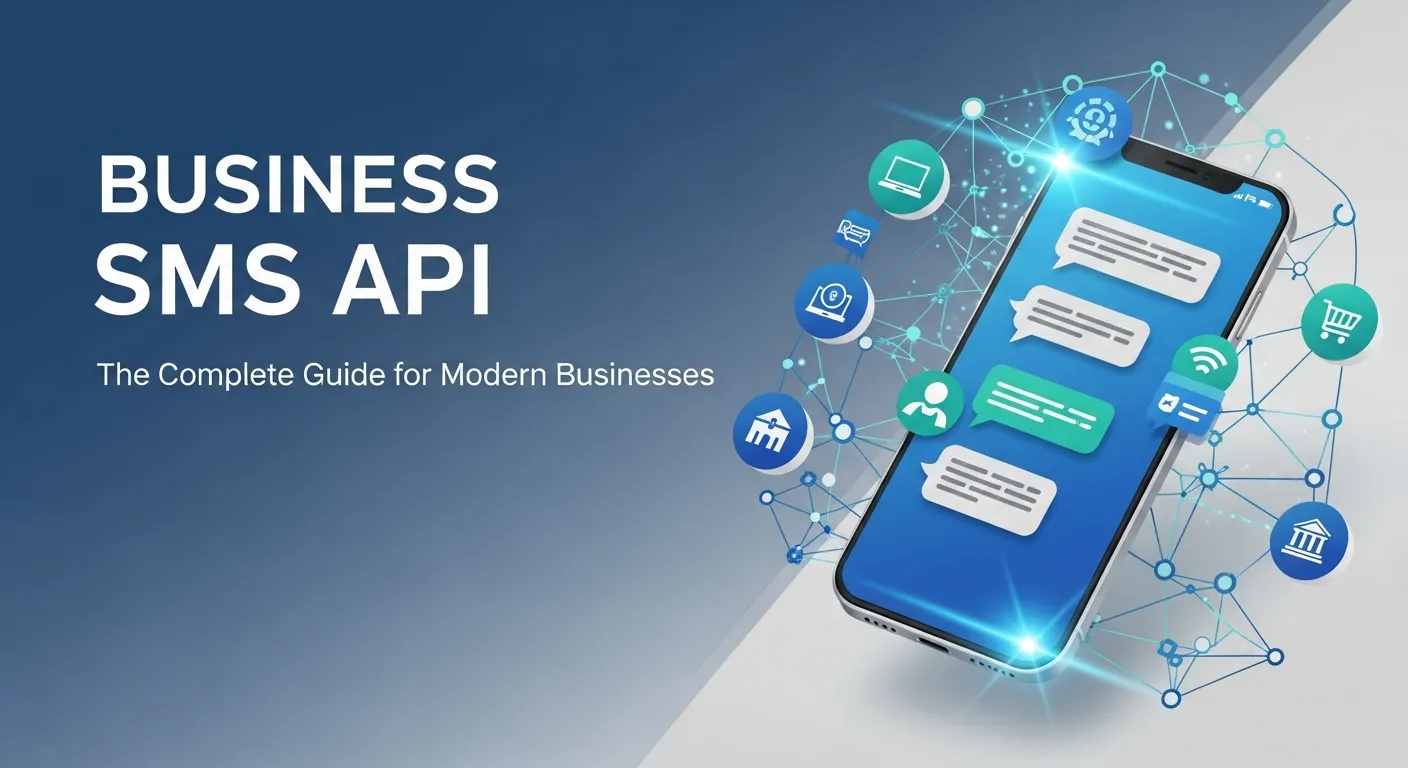
A Business SMS API allows businesses to automate SMS communication through their applications, websites, and business software. It enables instant delivery of OTPs, notifications, reminders, and promotional messages, helping improve customer engagement, streamline operations, and enhance communication efficiency.
Businesses need fast, reliable, and direct communication with customers. While email inboxes are often crowded and mobile app notifications can be ignored, SMS continues to deliver one of the highest engagement rates available. This is why companies of all sizes are adopting a Business SMS API to automate customer communication and improve operational efficiency.
Whether you’re sending OTPs, delivery updates, appointment reminders, payment confirmations, marketing campaigns, or customer support notifications, a Business SMS API allows your software to send and receive SMS messages automatically without manual intervention.
This comprehensive guide explains everything you need to know about Business SMS APIs, their benefits, features, use cases, integrations, security considerations, and how to choose the right provider.
What is a Business SMS API?
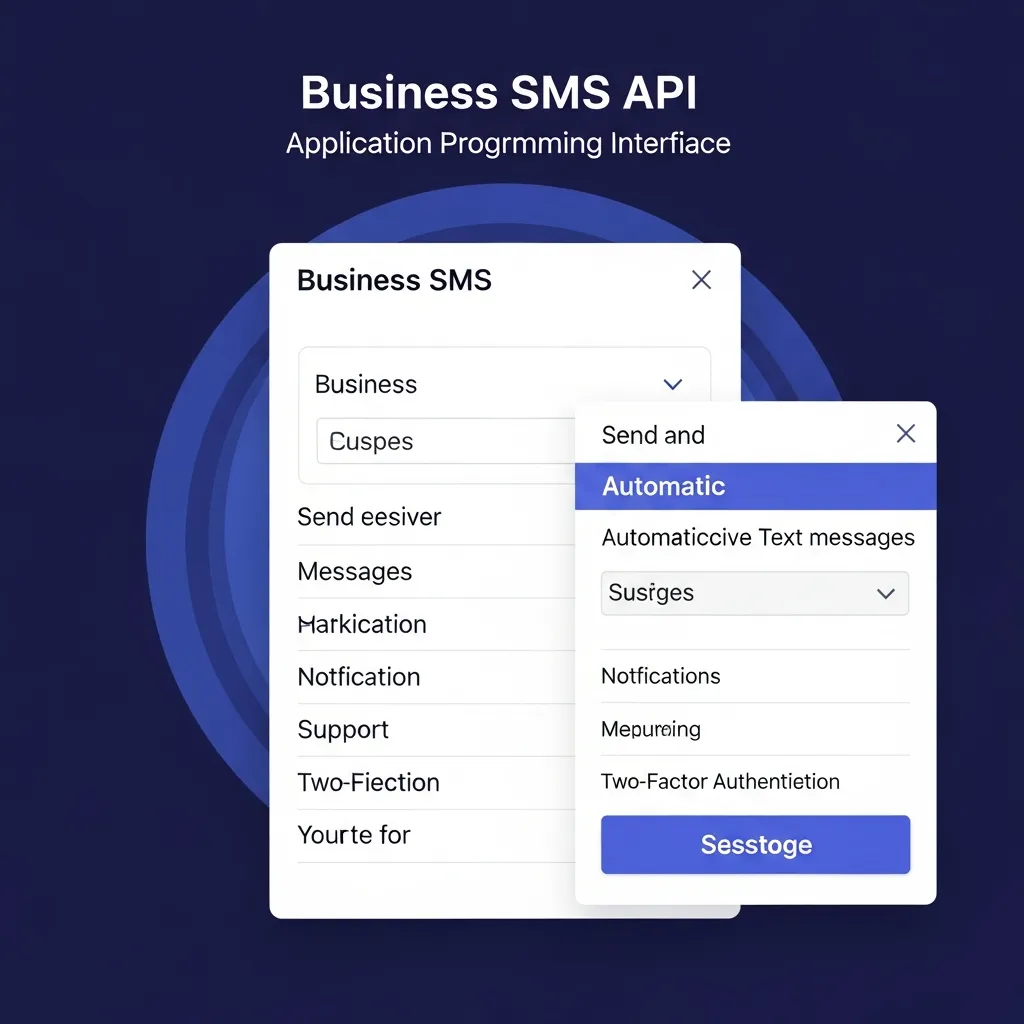
A Business SMS API (Application Programming Interface) is a software interface that allows businesses to integrate SMS messaging capabilities directly into their applications, websites, CRM systems, ERP platforms, eCommerce stores, and other business software. Rather than sending text messages manually from an SMS dashboard or mobile phone, a Business SMS API enables organizations to automate SMS communication through code. This creates a seamless and efficient way to interact with customers, employees, and partners.
By connecting your software to an SMS gateway, the API can automatically send messages whenever a specific event occurs. For example, when a customer creates an account, places an order, schedules an appointment, or requests a password reset, the application can instantly trigger an SMS without requiring human intervention. Similarly, businesses can receive incoming SMS messages, process customer replies, and automate workflows based on those responses.
Business SMS APIs are widely used across industries because they provide a reliable and scalable communication channel. Unlike email, which may end up in spam folders or remain unread for hours, SMS messages are typically delivered within seconds and read almost immediately. This makes SMS one of the most effective methods for delivering time-sensitive information.
Common use cases include:
- Customer verification codes (OTP)
- Shipping and delivery notifications
- Appointment reminders
- Marketing and promotional campaigns
- Payment confirmations
- Emergency alerts
- Internal employee notifications
- Customer support updates
- Event registration confirmations
- Subscription renewal reminders
Whether you’re a startup sending a few hundred messages per month or a global enterprise delivering millions of SMS messages daily, a Business SMS API offers the flexibility, automation, and reliability needed to streamline communication.
Why Businesses Need an SMS API
Customer expectations have evolved significantly over the past decade. Modern consumers expect businesses to provide instant, personalized, and reliable communication across every stage of the customer journey. Delayed responses or missed notifications can lead to poor customer experiences, lost sales, and decreased brand trust. A Business SMS API helps organizations meet these expectations by enabling real-time communication at scale.
Unlike traditional messaging methods that require employees to manually send texts, SMS APIs automate the entire process. Businesses can instantly notify customers about order confirmations, payment receipts, shipping updates, appointment reminders, account activity, and service alerts without any manual effort. This not only saves time but also minimizes the risk of human error.
Some of the biggest reasons businesses invest in an SMS API include:
- Improve customer engagement with timely, personalized communication.
- Automate repetitive messaging tasks to reduce operational workload.
- Increase efficiency by integrating messaging directly into existing business applications.
- Reduce manual errors through automated workflows.
- Improve customer satisfaction with instant updates and notifications.
- Deliver critical information in real time.
- Increase response and conversion rates compared to email or other communication channels.
- Strengthen customer relationships through proactive communication.
SMS is also one of the most universally accessible communication channels. Nearly every mobile phone can receive text messages without requiring an internet connection or additional applications. This broad accessibility makes SMS an ideal solution for businesses serving diverse customer bases across different regions and devices.
How a Business SMS API Works
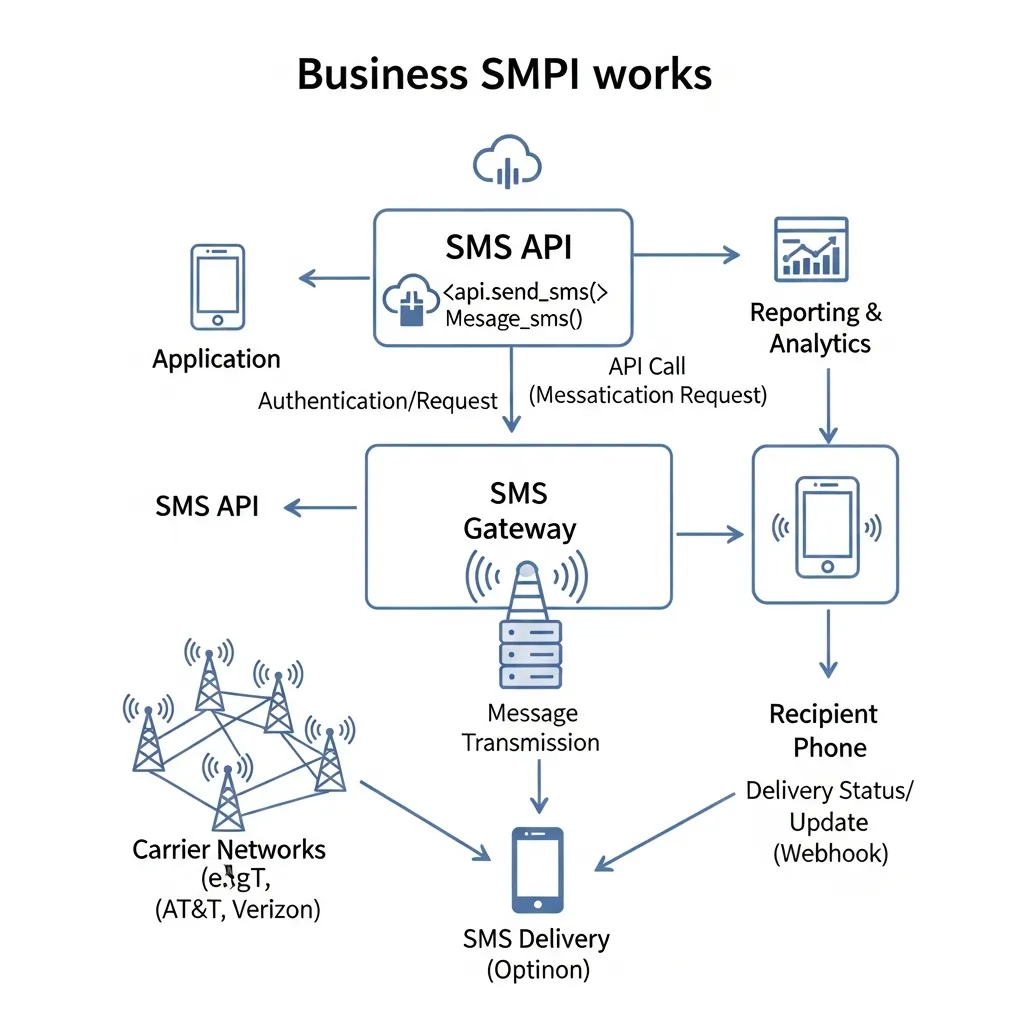
A Business SMS API acts as a bridge between your business application and an SMS gateway, allowing your software to exchange messaging data automatically. Once integrated, your application can send SMS messages based on predefined business rules or customer actions.
Here’s how the process typically works:
- A customer performs an action, such as placing an order, creating an account, scheduling an appointment, or requesting a password reset.
- Your application detects the event and generates an API request containing the recipient’s phone number, message content, authentication credentials, and other required parameters.
- The API securely sends the request to the SMS gateway.
- The SMS gateway validates the request and forwards the message to the appropriate mobile network operator.
- The customer’s mobile carrier delivers the SMS to the recipient’s device.
- The SMS provider sends delivery reports back to your application, allowing you to monitor message status in real time.
This entire process usually takes only a few seconds. Modern SMS APIs also support advanced capabilities such as message scheduling, two-way messaging, delivery tracking, number validation, and webhook notifications, enabling businesses to build highly automated communication workflows.
Key Features of a Business SMS API
A modern Business Text Messaging API offers much more than simple SMS delivery. It provides a comprehensive set of features that help businesses automate communication, monitor performance, improve security, and create better customer experiences.
Some of the most valuable features include:
- SMS Sending: Instantly send individual or bulk text messages from your applications.
- SMS Receiving: Receive inbound customer replies for two-way communication.
- Two-Way Messaging: Enable conversations between customers and support teams.
- Delivery Reports: Track whether messages have been delivered successfully.
- Number Validation: Verify phone numbers before sending messages to reduce failures.
- OTP Verification: Secure user authentication through one-time passwords.
- Scheduling: Schedule messages for future delivery at specific dates and times.
- Bulk Messaging: Send thousands or even millions of SMS messages simultaneously.
- Personalization: Customize messages using customer names, order numbers, appointment times, and other dynamic data.
- Webhooks: Receive real-time event notifications whenever message statuses change.
- Global Coverage: Deliver messages across multiple countries and mobile carriers.
- High Availability: Enterprise-grade infrastructure ensures reliable message delivery with minimal downtime.
- Developer SDKs: Simplify integration using SDKs for popular programming languages.
- Analytics Dashboard: Monitor message volume, delivery rates, response rates, and campaign performance.
- Security Features: Protect sensitive customer data using encryption, API keys, and authentication protocols.
These capabilities allow businesses to automate communication while maintaining reliability, scalability, and security.
SMS API Authentication and Security Mechanisms
Security is one of the most critical components of any Business SMS API, especially when handling sensitive customer data such as OTPs, banking alerts, payment confirmations, and personal information. To ensure secure communication between applications and SMS gateways, modern APIs use multiple layers of authentication and encryption.
Most SMS APIs rely on API keys, which act as unique identifiers that allow only authorized applications to access the service. These keys must be kept confidential and are often restricted by usage limits or IP addresses. In more advanced systems, OAuth tokens are used to provide temporary, secure access without exposing long-term credentials.
Another important security layer is IP whitelisting, where only approved server IP addresses are allowed to make API requests. This prevents unauthorized systems from sending messages even if credentials are compromised.
In addition, all communication between the application and the SMS gateway is protected using SSL/TLS encryption, ensuring that data such as phone numbers, message content, and authentication details cannot be intercepted during transmission.
Security is especially important for industries like banking, fintech, healthcare, and eCommerce, where SMS messages often contain sensitive or time-critical information. A secure SMS API not only protects customer trust but also ensures compliance with data protection regulations and industry standards.
SMS API Pricing Models Explained
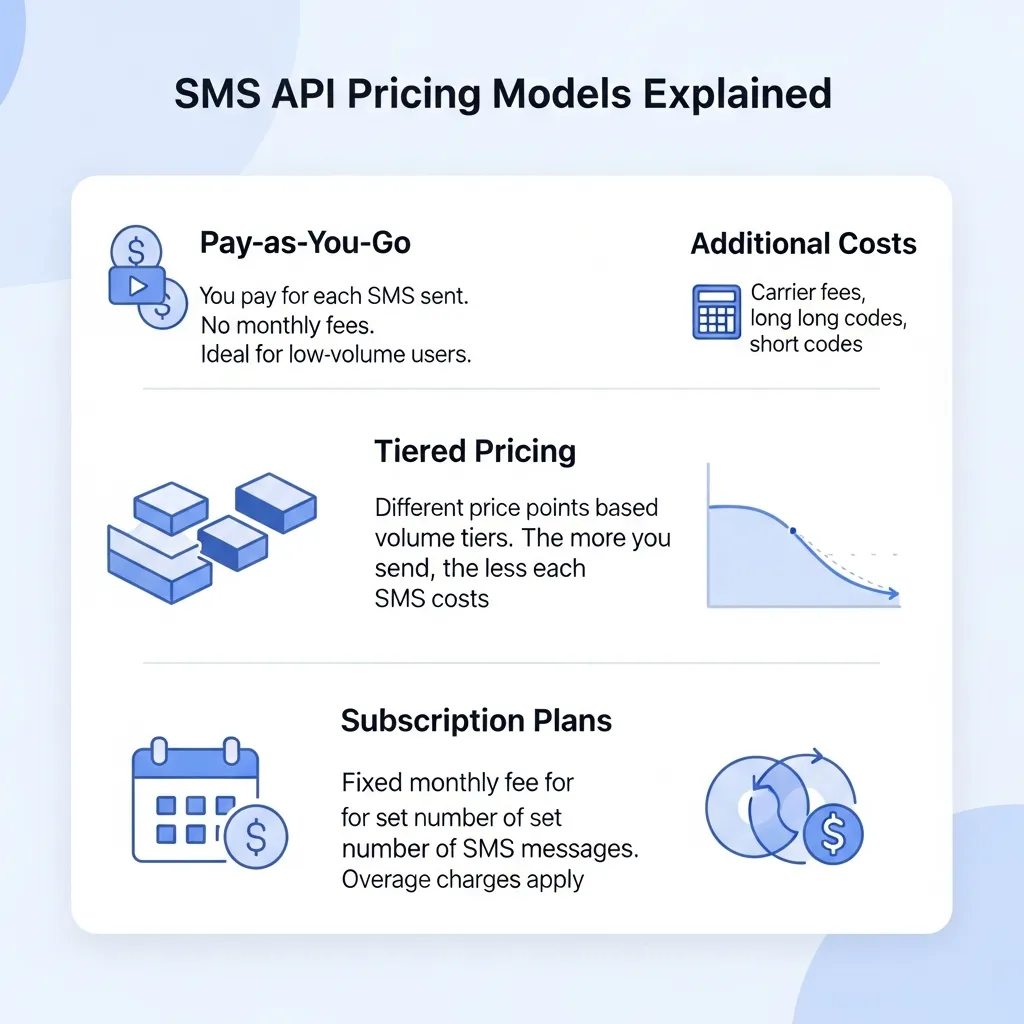
Business SMS APIs offer flexible pricing structures designed to meet the needs of startups, SMEs, and large enterprises. Understanding these pricing models helps businesses control communication costs while maintaining scalability.
The most common model is pay-per-message pricing, where businesses are charged for each SMS sent. This model is ideal for small businesses or applications with unpredictable messaging volumes because it allows full control over spending without long-term commitments.
Another popular option is monthly subscription plans, where businesses pay a fixed fee that includes a set number of SMS messages and additional features like analytics, delivery reports, or dedicated support. This model is suitable for companies with consistent messaging needs.
For large organizations, enterprise contracts are often used. These are custom agreements that include bulk messaging discounts, dedicated infrastructure, priority delivery routes, and advanced support services. Enterprises benefit from lower per-message costs due to high volume commitments.
Additionally, most providers offer volume-based discounts, where the cost per SMS decreases as messaging volume increases. This makes scaling more cost-efficient for growing businesses.
To optimize SMS costs, businesses should segment their messages into transactional and promotional categories, eliminate unnecessary messaging, validate phone numbers before sending, and choose the right pricing plan based on usage patterns and geography.
Role of SMS APIs in Customer Journey Automation
A Business SMS API plays a powerful role in automating the entire customer journey, ensuring timely communication at every stage of interaction between a business and its customers.
During the onboarding stage, SMS APIs are used to send welcome messages, account verification codes, and setup instructions. This helps businesses create a smooth first impression and reduce drop-off rates.
In the verification phase, SMS APIs deliver OTPs and security codes that ensure safe user authentication. This is especially important for banking apps, fintech platforms, and online services requiring identity confirmation.
Throughout the purchase or service stage, SMS APIs send real-time updates such as order confirmations, payment receipts, shipping notifications, and appointment reminders. These automated messages keep customers informed and reduce support inquiries.
In the retention phase, SMS APIs help businesses maintain engagement by sending personalized offers, loyalty rewards, subscription renewals, and feedback requests.
Finally, during the re-engagement stage, SMS APIs are used to bring inactive users back through targeted promotions, reminders, and special offers.
By integrating SMS APIs into automated workflows, businesses can deliver consistent communication throughout the entire customer lifecycle, improving satisfaction, retention, and long-term loyalty.
Benefits of Using an Enterprise SMS API
As organizations grow, their communication requirements become more complex. Large enterprises often need to deliver millions of SMS messages each month across multiple departments, countries, and business systems. An Enterprise SMS API is specifically designed to meet these large-scale messaging requirements while maintaining high performance, security, and reliability.
One of the primary advantages is scalability. Enterprise APIs can process massive volumes of SMS traffic without affecting system performance, making them suitable for banks, healthcare providers, eCommerce companies, telecommunications providers, and global enterprises.
Security is another major benefit. Enterprise SMS platforms typically support encrypted communication, secure API authentication, IP whitelisting, access controls, and compliance with industry regulations. These features help protect sensitive customer information and reduce cybersecurity risks.
Enterprise SMS APIs also provide:
- High-speed message delivery across global carrier networks.
- Intelligent routing to maximize delivery success rates.
- Automatic failover systems for improved uptime.
- Advanced reporting and analytics.
- Dedicated account management and technical support.
- Multi-region infrastructure for global communication.
- Easy integration with CRM, ERP, and business intelligence systems.
- Flexible APIs that support customized workflows and automation.
In addition to operational efficiency, enterprise SMS APIs often reduce communication costs by automating repetitive messaging tasks and minimizing manual intervention. This enables organizations to improve customer service while controlling operational expenses.
Frequently Asked Questions (FAQs)
What is a Business SMS API?
A Business SMS API allows applications and software to send and receive SMS messages automatically through programming interfaces.
How does a Business Text Messaging API work?
It connects your application to an SMS gateway, enabling automated SMS communication based on specific events.
What is an Enterprise SMS API?
An Enterprise SMS API is a scalable messaging solution designed for organizations sending high volumes of SMS messages securely.
What is the difference between transactional and promotional SMS?
Transactional SMS delivers essential notifications like OTPs and receipts, while promotional SMS is used for marketing campaigns.
What is a Bulk SMS API for Business?
It enables businesses to send thousands or millions of SMS messages simultaneously to multiple recipients.
What is an SMS Gateway for Businesses?
An SMS gateway connects applications to mobile carriers, ensuring reliable SMS delivery.
What is a Cloud SMS API?
A Cloud SMS API is a hosted messaging solution that eliminates the need for on-premise SMS infrastructure.
Can SMS APIs integrate with CRM systems?
Yes. Most modern SMS APIs integrate with CRM, ERP, eCommerce, and marketing automation platforms.
Are Business SMS APIs secure?
Yes. Most providers offer encryption, API authentication, access controls, and compliance with industry standards.
Which industries use Business SMS APIs?
Healthcare, banking, retail, logistics, education, travel, SaaS, insurance, and government organizations commonly use SMS APIs.
What programming languages support SMS APIs?
Most providers offer SDKs for PHP, Python, Java, JavaScript, Node.js, .NET, Ruby, and Go.
Can I automate SMS notifications?
Yes. Automated Business SMS allows messages to be triggered by user actions or scheduled events.
How much does a Business SMS API cost?
Pricing varies by provider, destination country, SMS volume, and additional features such as dedicated numbers and analytics.
Can I send international SMS using a Business SMS API?
Yes. Most enterprise providers support global messaging across hundreds of countries.
What should I consider when choosing an SMS API provider?
Evaluate uptime, pricing, API documentation, security, global coverage, scalability, customer support, and delivery performance.