
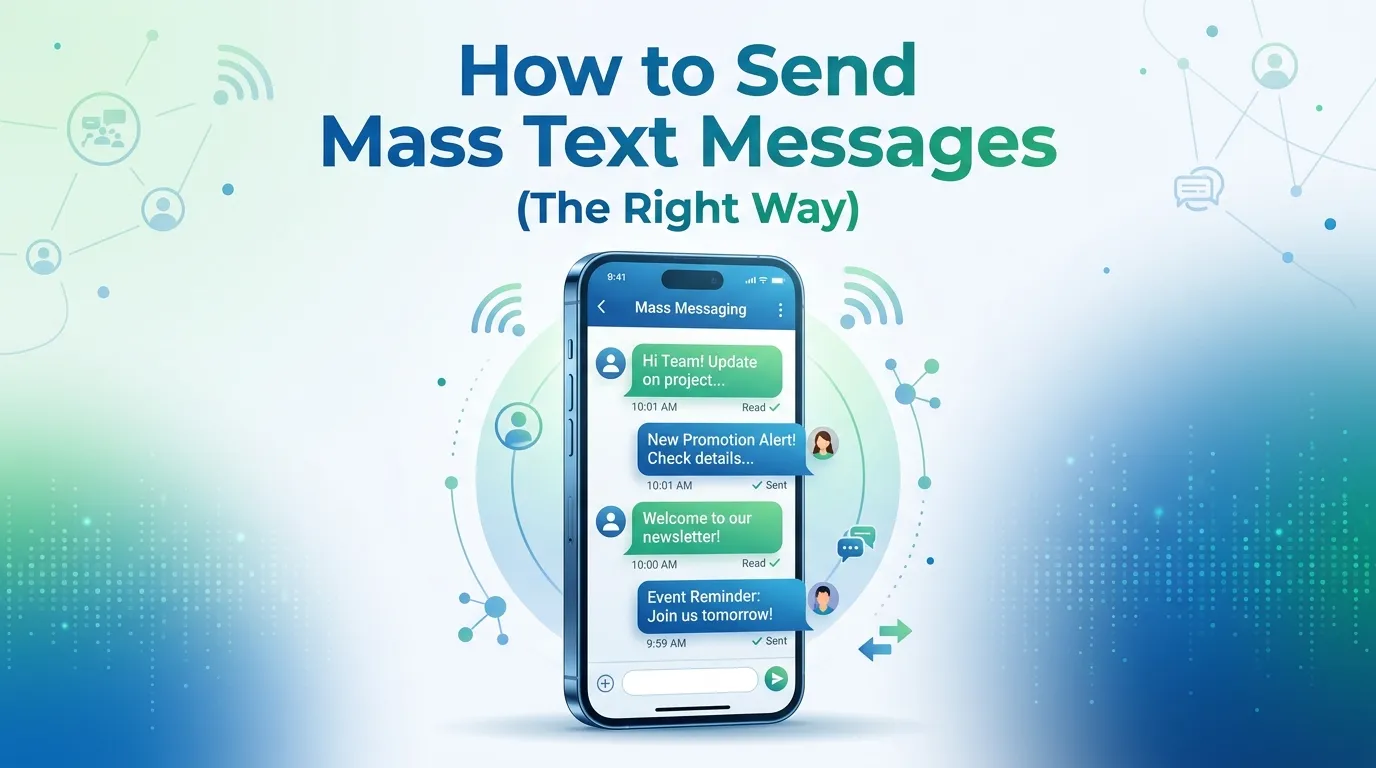
Mass text messaging lets businesses send SMS campaigns to large groups of opted-in contacts using bulk SMS platforms like EZTexting, SimpleTexting, or Twilio. It delivers very high open rates compared to email, making it effective for promotions, reminders, and updates. However, success depends on compliance, audience segmentation, and clear messaging. When used correctly, SMS marketing offers fast, direct, and high-ROI customer communication.
To send mass text messages, choose a bulk SMS platform (like EZTexting, SimpleTexting, or Twilio), upload your contact list, compose your message, and schedule or send your campaign. Most platforms also support opt-in management, automation, and analytics—making mass texting scalable for businesses of any size.
Email open rates hover around 20–30%. Mass text messages? They routinely hit 90–98%, with most read within three minutes of delivery. For businesses trying to cut through the noise, SMS isn’t just another channel—it’s often the most direct line to a customer’s attention.
But sending a mass text isn’t as simple as firing off a group chat. There are legal requirements to navigate, platforms to compare, and strategy choices that determine whether your campaign drives revenue or drives unsubscribes. Get the fundamentals wrong and you’ll waste budget, damage your brand, or worse—violate regulations like the TCPA (Telephone Consumer Protection Act) in the US.
This guide covers everything you need to know about how to send mass text messages effectively: from choosing the right bulk SMS platform and building a compliant contact list, to writing messages that convert and automating your campaigns for scale.
What Is Bulk SMS Marketing, and Why Does It Work?
Bulk SMS marketing is the practice of sending a single text message to a large list of opted-in contacts simultaneously. Businesses use it for promotions, appointment reminders, flash sales, event notifications, and customer service updates.
The reason it works comes down to behavior. People carry their phones everywhere and check them constantly. Unlike email—where messages sit unread for hours or days—an SMS typically lands in a notification that’s hard to ignore. According to Gartner, SMS messages have a response rate six to eight times higher than email.
It’s also cost-effective. Most bulk SMS platforms charge between $0.01 and $0.05 per message, depending on volume and plan. For a business sending 10,000 messages, that’s a potential $50–$500 investment to reach an audience that’s almost guaranteed to see your content.
How to Send Mass Text Messages: A Step-by-Step Guide
Step 1: Choose a Bulk SMS Marketing Service
The platform you choose will shape everything—your cost per message, deliverability rates, compliance tools, and automation capabilities. Here are the most widely used bulk SMS platforms for business:
- EZTexting – Best for small to mid-sized businesses. Offers a simple interface, keyword opt-ins, and MMS support.
- SimpleTexting – Strong analytics and two-way messaging; great for customer engagement campaigns.
- Twilio – A developer-friendly API that suits businesses that want to build custom SMS workflows at scale.
- Klaviyo – Ideal for e-commerce brands already using email marketing, as it integrates SMS and email in one platform.
- SlickText – Focused on loyalty programs and drip campaigns, with solid automation features.
Choose a platform based on your use case: If you need simple broadcast messaging, EZTexting or SimpleTexting will serve you well. If you’re building automated SMS sequences tied to customer behavior, Klaviyo or Twilio offers more flexibility.
Step 2: Build and Import Your Contact List
You cannot legally send mass text messages to people who haven’t explicitly opted in. In the United States, the TCPA requires prior written consent before sending promotional SMS. Non-compliance can result in fines of $500–$1,500 per message.
Here’s how to build a compliant contact list:
- Keyword opt-ins: Invite customers to text a keyword (e.g., “JOIN”) to a shortcode or long code number. The platform captures their number and consent automatically.
- Web forms: Add an SMS opt-in checkbox to your website signup or checkout forms. Make sure the consent language is explicit and visible.
- In-store sign-ups: Collect numbers at the point of sale with a tablet or paper form that includes clear consent wording.
- QR codes: Link a QR code on packaging or signage to a mobile opt-in page.
Once contacts are collected, most platforms let you upload them via CSV file or sync with your CRM (like HubSpot, Salesforce, or Shopify).
Step 3: Segment Your Audience
Sending the same message to every contact on your list is a missed opportunity. Segmentation lets you tailor content to different customer groups, which improves relevance and reduces opt-outs.
Common segmentation strategies include:
- Purchase history – Send a restock alert only to customers who bought that product before.
- Geography – Promote a local event only to contacts within a certain radius.
- Engagement level – Send a re-engagement offer to subscribers who haven’t responded in 60+ days.
- Opt-in source – Personalize messaging based on how someone joined your list.
Most bulk SMS platforms support list segmentation natively, either through tags, custom fields, or integration with your CRM data.
Step 4: Write a Message That Gets Results
Mass text messages live or die by their copy. You have 160 characters in a standard SMS—every word counts.
Follow these principles when writing for SMS:
- Lead with value. State the offer or key information in the first line. Don’t make the reader work for it.
- Include a clear call to action. Tell people exactly what to do: “Shop now,” “Reply YES,” “Claim your spot.”
- Personalize where possible. Most platforms support merge tags (e.g., “Hi [First Name]”). Personalized messages consistently outperform generic ones.
- Always identify your brand. Start with your business name so recipients immediately know who’s messaging them.
- Include opt-out instructions. In the US, you’re legally required to include a way for recipients to unsubscribe (e.g., “Reply STOP to opt out”).
Example:
“Hi [Name], it’s Bloom Florist! 🌸 Get 20% off your next order this weekend only. Use code BLOOM20 at checkout: [link]. Reply STOP to opt out.”
Short, specific, and actionable—that’s the sweet spot.
Step 5: Schedule or Send Your Campaign
Timing matters. Sending a mass text at 7 AM on a Sunday will generate opt-outs, not conversions. As a general rule:
- Best days: Tuesday, Wednesday, and Thursday consistently show higher engagement rates.
- Best times: Between 10 AM–12 PM and 5 PM–7 PM in the recipient’s local time zone.
- Avoid: Early mornings, late evenings, and holidays (unless the message is holiday-specific).
Most bulk SMS platforms include scheduling tools that let you set a future send time. If your list spans multiple time zones, look for platforms that support time-zone-based scheduling—this sends each message at the optimal local time automatically.
Best Automated Mass Texting Software Features to Look For
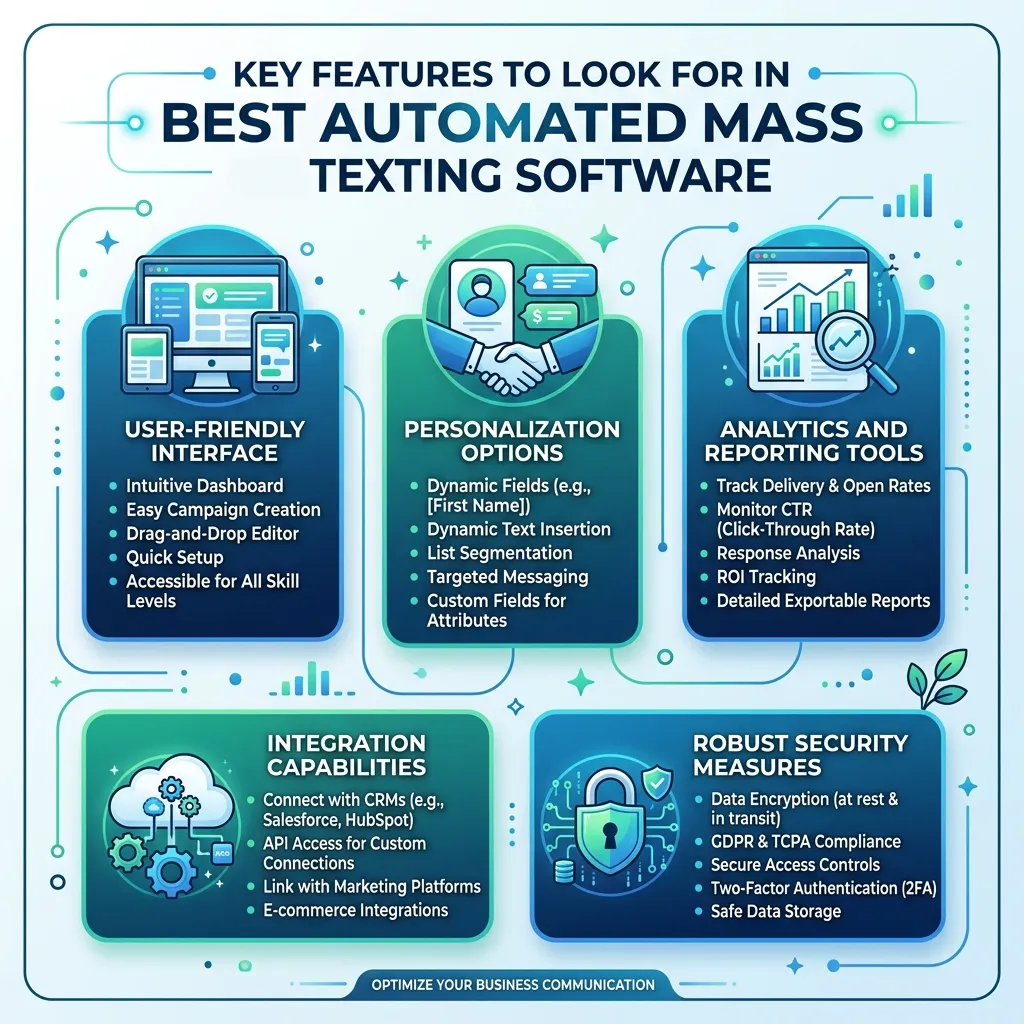
Automation is what transforms a one-off text blast into a scalable SMS marketing strategy. When evaluating mass texting apps for your business, prioritize these features:
- Drip campaigns: Automated sequences triggered by opt-ins, purchases, or time delays. For example, send a welcome message immediately after someone joins your list, followed by an offer three days later.
- Triggered messages: Automate texts based on customer behavior, such as an abandoned cart reminder or a post-purchase follow-up.
- Two-way messaging: Allow customers to respond to your texts and manage conversations through a shared inbox.
- Analytics dashboard: Track delivery rates, open rates, click-through rates, and opt-out rates at the campaign level.
- Compliance tools: Look for platforms that automatically append opt-out language and manage unsubscribes in real time.
- Integrations: Native connections to Shopify, WooCommerce, HubSpot, Mailchimp, and Zapier expand what you can automate.
Bulk SMS Campaign Strategies That Drive Real Results
Knowing how to send mass text messages is only part of the equation. Here’s how businesses use SMS campaigns to generate measurable outcomes:
Flash Sales and Limited-Time Offers
The urgency of SMS pairs perfectly with time-sensitive promotions. A message like “Today only: 30% off sitewide. Ends at midnight.” drives immediate action because recipients know they can’t defer it.
Appointment and Event Reminders
Healthcare providers, salons, gyms, and event organizers use mass texting to reduce no-shows. Automated reminder sequences (e.g., 48 hours before, then again 2 hours before) can cut no-show rates dramatically.
Loyalty and VIP Programs
Reward your most engaged customers with exclusive SMS-only offers. Creating a VIP segment that receives early access to sales or special perks builds loyalty and increases lifetime value.
Re-engagement Campaigns
If a portion of your list hasn’t engaged in 90+ days, an automated re-engagement sequence can recover a percentage of them before you remove inactive contacts. A simple “We miss you” offer often performs surprisingly well.
Transactional Updates
Order confirmations, shipping notifications, and delivery updates via SMS keep customers informed and reduce inbound customer service volume. These messages also have near-perfect open rates because they’re expected and relevant.
Group Text Messaging for Business: Common Mistakes to Avoid
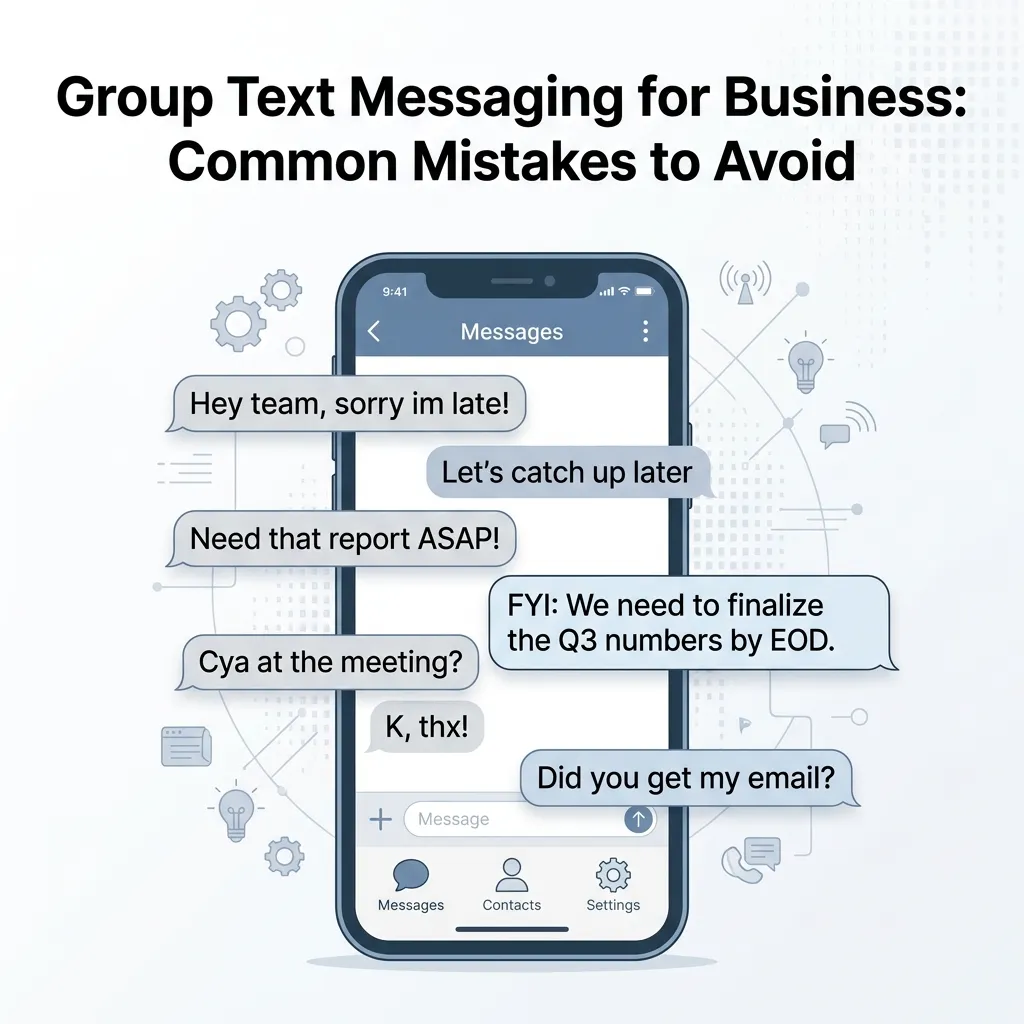
Even well-intentioned campaigns can go sideways. Watch out for these pitfalls:
- Sending without consent – Always verify that every contact on your list has explicitly opted in. There are no shortcuts here.
- Messaging too frequently – More than 4–6 messages per month is generally considered excessive for most industries.
- Using long, dense copy – If your message needs more than 160 characters, reconsider whether SMS is the right channel for that content.
- Ignoring analytics – If you’re not tracking opt-out rates, click-through rates, and conversions, you can’t improve. Review campaign performance after every send.
- Neglecting list hygiene – Remove bounced numbers and inactive contacts regularly to maintain deliverability and keep costs down.
The Bottom Line on Mass Text Messaging for Business
Mass text messaging is one of the highest-ROI marketing channels available to businesses today—but only when executed correctly. The platforms are accessible, the costs are low, and the reach is immediate. What separates effective campaigns from wasted sends is a compliant contact list, well-timed messages, smart segmentation, and a consistent strategy.
Start small if you’re new to bulk SMS: pick one use case (like a promotional campaign or appointment reminders), test it with a segment of your list, and measure the results before scaling. Most platforms offer free trials, so you can explore the tools before committing.
The contacts on your SMS list have given you direct access to their phones. Use that access thoughtfully, and SMS marketing will consistently deliver.
Frequently Asked Questions
What is the best platform for sending mass text messages to customers?
The best platform depends on your needs. EZTexting and SimpleTexting are ideal for businesses wanting simple, no-code campaign tools. Twilio suits developers who need custom workflows. Klaviyo works best for e-commerce businesses integrating SMS with email marketing.
How much does it cost to send mass text messages?
Most bulk SMS platforms charge between $0.01 and $0.05 per message, with pricing varying by volume and plan tier. Many platforms also offer monthly subscription plans that include a set message allowance.
Is it legal to send mass text messages to customers?
Yes, provided you have explicit written consent from each recipient. In the United States, the TCPA governs SMS marketing. Violations can result in fines of $500–$1,500 per unsolicited message. Always include opt-out instructions in every promotional text.
How many texts can I send in a bulk SMS campaign?
There’s no universal limit—most platforms can handle lists of tens of thousands of contacts. Your sending capacity depends on your platform plan and the type of number you’re using (shortcode numbers typically support higher throughput than long codes).
What’s the difference between a shortcode and a long code for mass texting?
A shortcode is a 5–6 digit number used for high-volume, one-way messaging (e.g., promotions). A long code is a standard 10-digit number that supports two-way conversations but has lower throughput. For mass texting campaigns at scale, shortcodes are generally more reliable.
How do I grow my SMS subscriber list legally?
Use keyword opt-ins, web forms with explicit consent language, in-store sign-up sheets, and QR codes. Never purchase phone number lists—doing so almost always violates consent requirements and delivers poor results.
What is mass text messaging?
Mass text messaging is the process of sending a single SMS to a large group of opted-in contacts using a bulk SMS platform.
How do I send mass text messages?
You can use a bulk SMS service, upload your contact list, create your message, and schedule or send it instantly.
What are the best platforms for mass texting?
Popular platforms include EZTexting, SimpleTexting, Twilio, Klaviyo, and SlickText.
Is mass text messaging legal?
Yes, but only if you have explicit consent from recipients and follow regulations like the TCPA in the US.
How much does bulk SMS marketing cost?
Costs typically range from $0.01 to $0.05 per message, depending on volume and provider.
Why is SMS marketing so effective?
SMS messages have very high open rates (around 90%+) and are usually read within minutes.
Can I send mass texts without permission?
No. Sending messages without opt-in consent is illegal in many countries and can result in fines.
What is the difference between SMS and MMS in mass texting?
SMS is text-only, while MMS allows images, videos, and multimedia content.
How can I grow my SMS subscriber list?
You can use web forms, keyword opt-ins, QR codes, and in-store signups with clear consent.
How often should I send mass text messages?
Most businesses send 2–6 messages per month to avoid unsubscribes and maintain engagement.